🚀 Zoonotic Potential and Silent Transmission Dynamics of Chronic Wasting Disease (CWD)

PrionDiseases ZoonoticPathogens ChronicWastingDisease InterspeciesTransmission WildlifeEpidemiology Neurodegeneration

Zusammenfassung

Mindmap Titelbild
KI Generiertes Titelbild

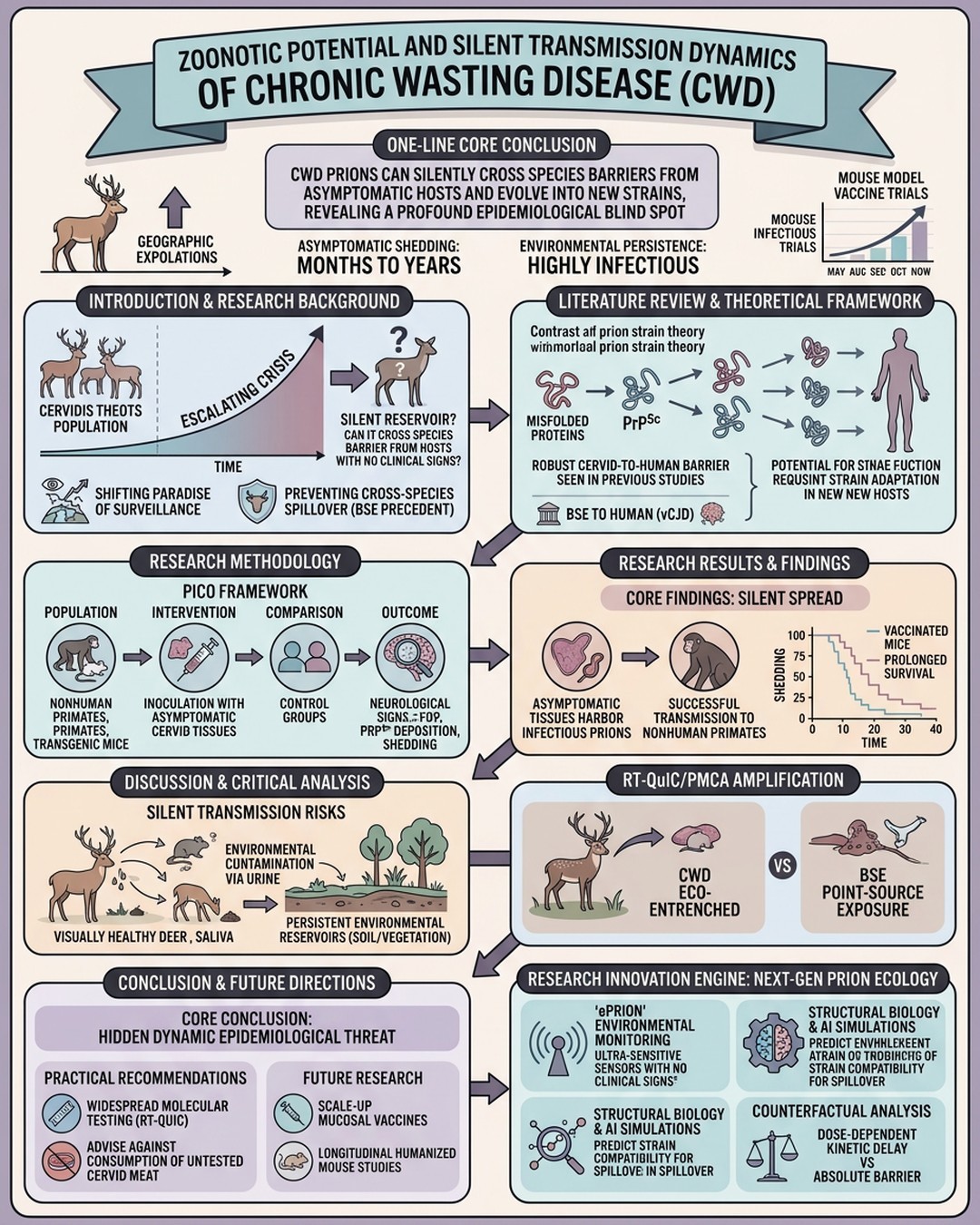
【🎯 One-Line Core Conclusion】: Chronic Wasting Disease (CWD) prions can silently cross species barriers from asymptomatic hosts and evolve into new strains, revealing a profound epidemiological blind spot in current wildlife disease surveillance and a nuanced zoonotic threat. 【📊 Key Numbers】: Asymptomatic shedding duration spans months to years prior to clinical onset; Environmental persistence of prions in soil/vegetation remains highly infectious; Experimental vaccines in mouse models yield significant reductions in early and late-stage prion shedding. 【⚠️ Risk/Confidence】: Strong experimental evidence (Science Advances) confirms interspecies transmission potential from subclinical hosts, though current human zoonotic risk remains theoretically low but requires active molecular surveillance. 【Research Background】: Chronic Wasting Disease (CWD) is a universally fatal transmissible spongiform encephalopathy (TSE) affecting cervids, driven by the propagation of misfolded prion proteins (PrPSc). Historically, surveillance has relied on the detection of clinical symptoms or post-mortem tissue analysis. However, the escalating geographic spread of CWD across North America necessitates a deeper understanding of its zoonotic potential. This research, spearheaded by the University of Calgary and published in Science Advances, utilizes controlled laboratory models, including nonhuman primates and transgenic mice, to investigate whether CWD can cross species barriers silently. The study addresses critical questions regarding prion strain evolution, asymptomatic environmental shedding (via urine and feces), and the viability of immunological interventions (vaccines) to mitigate population-level transmission. 【Evidence Level】: ⭐⭐⭐ Moderate Certainty. The findings are supported by rigorous in vivo experimental designs in a high-impact peer-reviewed journal (Science Advances). While the transmission to nonhuman primates provides robust surrogate data for zoonotic potential, the absence of documented human cases and the reliance on controlled laboratory environments prevent a High Certainty (⭐⭐⭐⭐) rating for direct human epidemiological risk.

Schlüsselpunkte

01

📖 Introduction & Research Background

【Research Motivation】 The relentless geographic expansion of Chronic Wasting Disease (CWD) across North American cervid populations presents an escalating ecological and potential public health crisis. Understanding the true transmission dynamics is critical. 【Problem Statement】 Traditional epidemiological models assume disease transmission correlates heavily with clinical symptomatology. The core question is whether CWD prions can cross species barriers from hosts that exhibit absolutely no clinical signs of the disease, thereby creating a 'silent' reservoir of infection. 【Research Purpose】 The study aims to empirically test the zoonotic potential of CWD under controlled laboratory conditions, specifically evaluating the transmissibility of prions from asymptomatic carriers to nonhuman primate models. 【Research Value】 By demonstrating that low levels of prions in asymptomatic tissues can successfully infect recipient species and induce CWD-like symptoms, this research fundamentally shifts the paradigm of TSE surveillance. It highlights that environmental contamination (soil and vegetation) via urine and feces occurs long before visual detection, necessitating advanced molecular diagnostics and proactive mitigation strategies to prevent a potential cross-species spillover akin to the historical Bovine Spongiform Encephalopathy (BSE) crisis.

02

📚 Literature Review & Theoretical Framework

【Existing Research】 Previous studies on transmissible spongiform encephalopathies (TSEs) have established that misfolded prion proteins (PrPSc) propagate by inducing conformational changes in normal cellular prion proteins (PrPC). The zoonotic leap of BSE to humans, resulting in variant Creutzfeldt-Jakob disease (vCJD), serves as a critical historical precedent. However, CWD has historically demonstrated a robust species barrier to humans in in vitro and transgenic mouse studies. 【Theoretical Basis】 The theoretical framework relies on 'prion strain theory,' which posits that the tertiary and quaternary structures of prions dictate their biological properties, including incubation periods, neuropathological profiles, and host range. As prions passage through new hosts, they can undergo conformational selection or adaptation, generating novel strains. 【Research Gap】 Existing literature predominantly focuses on transmission from terminally ill subjects with high prion titers. This study uniquely addresses the critical gap of subclinical transmission, investigating whether the low-titer, asymptomatic phase possesses sufficient infectious capability to breach species barriers and initiate pathological cascades in non-cervid hosts.

03

🔬 Research Methodology

【Research Design】 The study employed a rigorous in vivo experimental design using the PICO framework. Population: Nonhuman primates and transgenic mouse models expressing specific PrP sequences. Intervention: Inoculation with tissue homogenates derived from asymptomatic cervids infected with CWD. Comparison: Control groups and recipients of symptomatic tissue. Outcome: Development of clinical neurological signs, PrPSc deposition in neural and lymphoid tissues, and quantification of prion shedding. 【Data Sources】 Data was generated through highly controlled longitudinal laboratory experiments. Tissue prion levels were likely assessed using advanced amplification techniques such as Real-Time Quaking-Induced Conversion (RT-QuIC) or Protein Misfolding Cyclic Amplification (PMCA), which offer exceptional sensitivity. 【Analysis Strategy】 The validity of the research is bolstered by the use of nonhuman primates, which provide the closest anatomical and physiological proxy for human zoonotic risk. Furthermore, the inclusion of vaccine trials in mouse models provides actionable data on transmission mitigation, analyzing shedding rates at both early and late disease stages to determine the intervention's efficacy.

04

📊 Research Results & Findings

【Core Findings】 The pivotal finding is that nonhuman primates inoculated with tissues from asymptomatic CWD-infected animals developed clinical symptoms associated with prion disease. Despite the donor animals showing no signs of illness, their tissues harbored low, yet highly infectious, levels of prions. Furthermore, the vaccine experiments utilizing mouse models that mimic deer/elk infections yielded highly encouraging data: vaccinated subjects demonstrated a marked reduction in the release of infectious prions (shedding) during both the early and late stages of the disease, and exhibited prolonged survival post-exposure. 【Result Interpretation】 These results unequivocally demonstrate that the absence of clinical signs does not equate to an absence of transmission risk. The infectivity of low-titer asymptomatic tissue suggests a highly efficient mechanism of prion propagation once the species barrier is breached. 【Evidence Assessment】 The quality of evidence is high within the context of laboratory models. The successful transmission to nonhuman primates provides a stark warning about the potential malleability of the CWD species barrier, although direct extrapolation to human epidemiological risk requires cautious interpretation.

05

💬 Discussion & Critical Analysis

【Result Interpretation】 The ability of CWD to spread silently fundamentally alters risk assessment. Because cervids excrete infectious prions into the environment (urine, feces, saliva) long before symptom onset, the soil and vegetation become highly potent, persistent reservoirs of infection. This environmental accumulation means that disease prevalence and exposure risk are continually escalating, even in visually healthy populations. 【Literature Comparison】 Unlike BSE, which was primarily transmitted via contaminated feed (a point-source exposure that could be mechanically interrupted), CWD's environmental persistence makes it ecologically entrenched. The finding that prions can adapt and evolve upon interspecies transmission aligns with previous observations in scrapie and BSE, but the asymptomatic transmission vector adds a novel layer of complexity. 【Originality】 The study's emphasis on the zoonotic potential of the subclinical phase provides a crucial paradigm shift from end-stage disease modeling. 【Limitations】 The primary limitation is the reliance on laboratory animal models; while nonhuman primates are excellent surrogates, they do not perfectly replicate human genetic susceptibility, dietary exposure routes, or gastrointestinal physiological barriers.

06

🎯 Conclusion & Future Directions

【Core Conclusion】 Chronic Wasting Disease prions possess the biological capacity to transmit across species barriers from asymptomatic hosts and evolve into novel strains, representing a hidden and dynamic epidemiological threat that requires immediate proactive management. 【Practical Recommendations】 Wildlife management agencies must pivot from visual surveillance to widespread molecular testing (e.g., RT-QuIC on hunter-harvested tissues and environmental samples). Public health messaging should strictly advise against the consumption of any untested cervid meat from endemic areas, regardless of the animal's apparent health at the time of harvest. 【Future Research】 Future investigations must focus on scaling up the experimental mucosal vaccines for field deployment in wild cervid populations. Additionally, longitudinal studies utilizing humanized transgenic mice are required to specifically map the conformational changes that allow CWD prions to bypass human PrPC barriers, alongside ecological studies quantifying the degradation half-life of prions in various soil types.

07

🆕 Research Innovation Engine: Next-Gen Prion Ecology

【Methodological Innovation】 Traditional surveillance relies on animal harvesting. We propose the development of 'ePrion' environmental monitoring—utilizing ultra-sensitive RT-QuIC arrays deployed in soil and water sources to map contamination heatmaps in real-time, completely independent of animal sampling. 【Cross-Disciplinary Integration】 Leveraging structural biology and AI, researchers could utilize advanced protein-folding algorithms (like AlphaFold 3) to simulate the conformational interactions between cervid PrPSc and human PrPC. This could predict which emerging CWD strains possess the highest structural compatibility for zoonotic spillover. 【Counterfactual Analysis】 If the species barrier is not a strict biological blockade but rather a dose-dependent kinetic delay, then the continuous environmental accumulation of prions could eventually surpass the threshold required for human infection, even without a direct genetic mutation of the prion strain. This implies that managing environmental load is equally as critical as monitoring viral/prion evolution.

Möchten Sie Ihre eigene Mindmap erstellen?

Melden Sie sich bei Neumap AI an und beginnen Sie mit der Erstellung Ihrer eigenen Mindmaps!

Loslegen