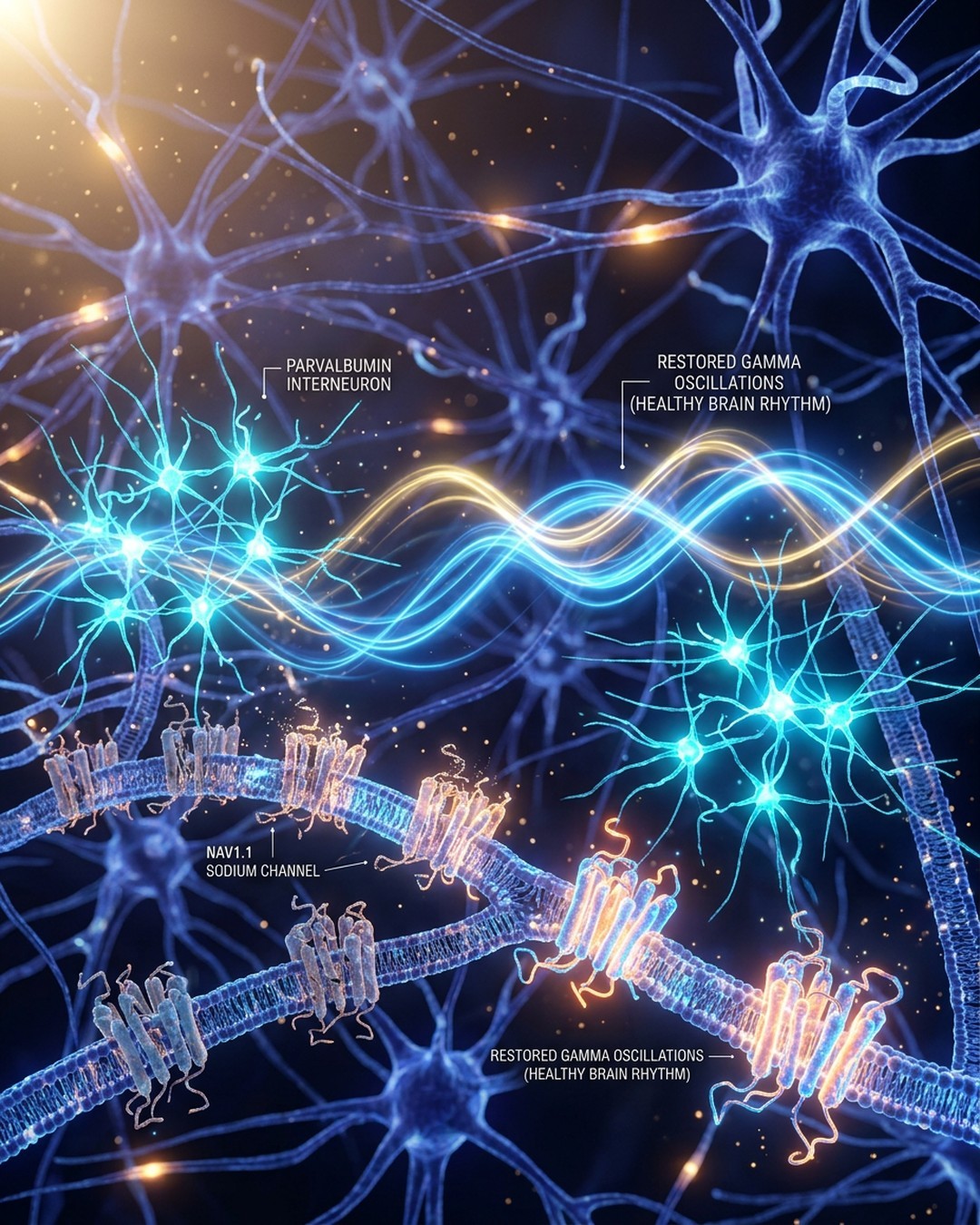
Published on October 19, 2026 (based on a study published October 15, 2026 in Neuron), researchers at the Gladstone Institutes and the Allen Institute demonstrated that boosting a single sodium channel protein called Nav1.1 restores brain rhythms and memory in mice engineered with Alzheimer's-like disease. The study focused on gamma oscillations (rapid electrical brain rhythms cycling 30 to 90 times per second essential for focus, learning, and memory) and how specialized brain cells called parvalbumin (PV) interneurons coordinate them. By combining real-time electrical recordings with fluorescent imaging of living cells in awake mice running on a treadmill, scientists observed that healthy PV cells fire in a precisely timed, sequential wave where roughly one-third of cells remain quiet. In Alzheimer's mice, this delicate sequence breaks down into excessive synchrony, weakening gamma rhythms and triggering epileptic spikes after sudden drops in PV cell activity.
Senior author Jorge J. Palop, PhD, and first author Keran Ma, PhD (now an assistant professor at UTHealth Houston), emphasize that healthy brain function depends on the precise dynamics and timing of cellular activity rather than sheer volume. Ma notes that 'more activity is not always going to produce better oscillations or better cognition,' while Palop compares healthy PV interneuron coordination to a dynamic 'flock of birds in the sky' rather than a rigid military lockstep march. The authors suggest that a significant portion of Alzheimer's pathology may arise downstream from early interneuron dysfunction and the resulting abnormal brain rhythms.
Strategically, the research team addressed the timing breakdown by targeting Nav1.1, a surface sodium channel protein on PV cells that is reduced in both Alzheimer's mouse models and human patients. Engineering Alzheimer's mice to produce higher levels of Nav1.1 successfully reset PV interneuron timing, strengthened gamma oscillations, reduced epileptic activity and amyloid plaques, and improved memory, cognition, and overall lifespan. Furthermore, co-authors Boaz P. Levi, PhD, and Jonathan T. Ting, PhD, at the Allen Institute developed cross-species genetic delivery vehicles capable of pinpointing PV interneurons out of hundreds of brain cell types in both mice and humans.
For medical researchers and drug developers, these findings shift the therapeutic paradigm from broadly increasing brain activity to precisely restoring cellular timing dynamics in specific neuron populations. Palop's team is currently developing small-molecule Nav1.1 enhancers to boost interneuron function in Alzheimer's and related neurological disorders, while utilizing Allen Institute genetic targeting tools to design precision therapies. Further human clinical investigation is required to confirm the link between PV cell failure, Nav1.1 levels, and why more than 25% of Alzheimer's patients experience epilepsy-like brain activity.