📚 Restoring Alzheimer's Memory via Nav1.1 Protein (Oct 2026)

SciTechDaily AlzheimersDisease Neuroscience GladstoneInstitutes AllenInstitute GammaOscillations ParvalbuminInterneurons Nav1.1Protein MemoryRestoration NeuronJournal

Samenvatting

Mindmap Omslagafbeelding
AI Gegenereerde Omslagafbeelding

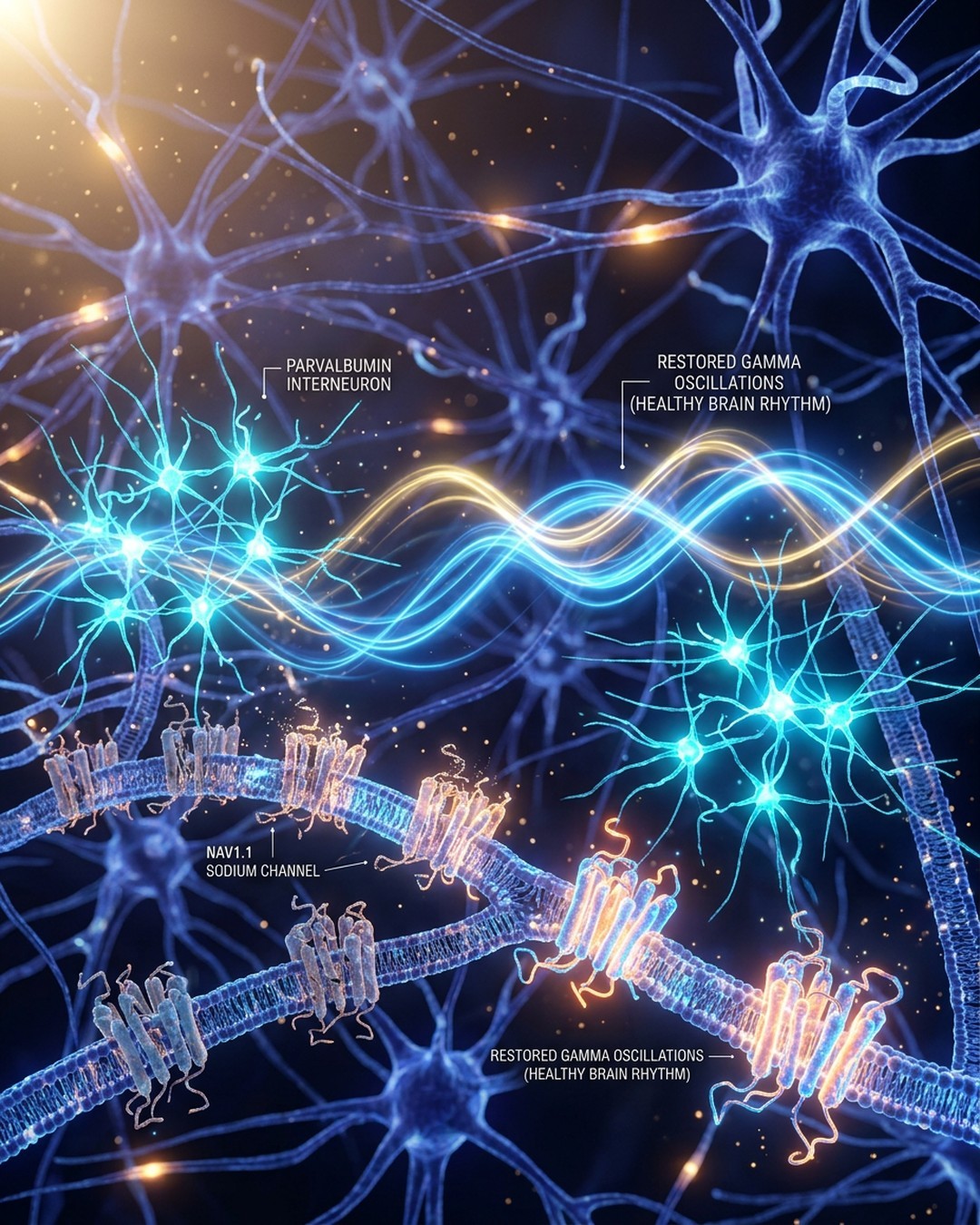
Published on October 19, 2026 (based on a study published October 15, 2026 in Neuron), researchers at the Gladstone Institutes and the Allen Institute demonstrated that boosting a single sodium channel protein called Nav1.1 restores brain rhythms and memory in mice engineered with Alzheimer's-like disease. The study focused on gamma oscillations (rapid electrical brain rhythms cycling 30 to 90 times per second essential for focus, learning, and memory) and how specialized brain cells called parvalbumin (PV) interneurons coordinate them. By combining real-time electrical recordings with fluorescent imaging of living cells in awake mice running on a treadmill, scientists observed that healthy PV cells fire in a precisely timed, sequential wave where roughly one-third of cells remain quiet. In Alzheimer's mice, this delicate sequence breaks down into excessive synchrony, weakening gamma rhythms and triggering epileptic spikes after sudden drops in PV cell activity. Senior author Jorge J. Palop, PhD, and first author Keran Ma, PhD (now an assistant professor at UTHealth Houston), emphasize that healthy brain function depends on the precise dynamics and timing of cellular activity rather than sheer volume. Ma notes that 'more activity is not always going to produce better oscillations or better cognition,' while Palop compares healthy PV interneuron coordination to a dynamic 'flock of birds in the sky' rather than a rigid military lockstep march. The authors suggest that a significant portion of Alzheimer's pathology may arise downstream from early interneuron dysfunction and the resulting abnormal brain rhythms. Strategically, the research team addressed the timing breakdown by targeting Nav1.1, a surface sodium channel protein on PV cells that is reduced in both Alzheimer's mouse models and human patients. Engineering Alzheimer's mice to produce higher levels of Nav1.1 successfully reset PV interneuron timing, strengthened gamma oscillations, reduced epileptic activity and amyloid plaques, and improved memory, cognition, and overall lifespan. Furthermore, co-authors Boaz P. Levi, PhD, and Jonathan T. Ting, PhD, at the Allen Institute developed cross-species genetic delivery vehicles capable of pinpointing PV interneurons out of hundreds of brain cell types in both mice and humans. For medical researchers and drug developers, these findings shift the therapeutic paradigm from broadly increasing brain activity to precisely restoring cellular timing dynamics in specific neuron populations. Palop's team is currently developing small-molecule Nav1.1 enhancers to boost interneuron function in Alzheimer's and related neurological disorders, while utilizing Allen Institute genetic targeting tools to design precision therapies. Further human clinical investigation is required to confirm the link between PV cell failure, Nav1.1 levels, and why more than 25% of Alzheimer's patients experience epilepsy-like brain activity.

Belangrijke punten

01

🔹 Healthy vs. Alzheimer's Parvalbumin (PV) Interneuron Dynamics

【📌 Key Finding】Rapid electrical rhythms called gamma oscillations (cycling 30 to 90 times per second) are essential for focus, skill learning, and memory retrieval, and are organized by specialized parvalbumin (PV) interneurons. 【🔵 Healthy Brain Dynamics】PV cells take precisely timed turns firing like passing a baton or a flock of birds in the sky → The first group of PV cells responds strongly → Successive groups fire with progressively weaker activity → Roughly one-third (1/3) of PV cells stay completely quiet. 【🟠 Alzheimer's Brain Breakdown】Initial PV cells respond sluggishly → Later participating cells become overactive → Fewer cells remain silent → More cells fire simultaneously at similar activity levels. 【⚖️ Key Differences & Impact】As first author Keran Ma, PhD, explains, excessive synchrony replaces the orderly sequence, which paradoxically weakens gamma rhythms. Furthermore, sudden drops in PV interneuron activity trigger epileptic spikes, helping explain why more than 25% (a quarter) of human Alzheimer's patients exhibit epilepsy-like brain activity.

02

🔸 Breakthrough Real-Time Imaging Methodology in Awake Mice

【📌 Limitations of Past Methods】Previously, scientists relied on techniques like optogenetics (using light to activate cells) to switch on all PV interneurons simultaneously. While this proved PV cells can generate gamma rhythms, it failed to show how cells naturally coordinate or recruit each other during spontaneous behavior. 【🔸 New Experimental Setup】Researchers at Gladstone Institutes combined real-time electrical recordings with live-cell fluorescent imaging in awake mice running on a treadmill (an activity that naturally induces attention-related brain rhythms). 【⭐ Technical Execution】PV interneurons were genetically engineered to glow fluorescently whenever they fired an electrical pulse, allowing scientists to simultaneously track individual cellular contributions alongside overarching gamma oscillations for the first time.

03

⭐ Nav1.1 Sodium Channel Protein Restoration & Therapeutic Outcomes

【📌 Molecular Target】Nav1.1 is a sodium channel protein located on the surface of PV cells that facilitates electrical pulse firing. Levels of Nav1.1 are significantly reduced in both Alzheimer's mouse models and humans with the disease. 【🔸 Experimental Intervention】Senior author Jorge J. Palop, PhD, and his team engineered Alzheimer's mice to produce increased amounts of Nav1.1 and monitored their brain activity. 【⭐ 5 Major Outcomes in Mice】Boosting Nav1.1 levels achieved comprehensive therapeutic benefits: Category 1: Restored normal sequential waves of PV interneuron activity / Category 2: Strengthened rapid gamma oscillations / Category 3: Reduced abnormal epileptic brain spikes / Category 4: Reduced amyloid plaques (a core pathological hallmark of Alzheimer's disease) / Category 5: Improved memory, cognitive performance, and overall lifespans.

04

📊 Cross-Species Genetic Targeting & Future Drug Development

【📌 Precision Delivery Tools】Study co-authors Boaz P. Levi, PhD, and Jonathan T. Ting, PhD, at the Allen Institute developed specialized genetic delivery vehicles capable of targeting a single cell type (PV interneurons) out of hundreds of different cell types in the brain. 【🔸 Cross-Species Application】Because these genetic targeting tools function effectively in both mice and humans, they bridge the translational gap between observing cellular failure in animal models and creating targeted human therapies. 【⭐ Next Steps in Drug Design】Palop's team is actively developing small-molecule Nav1.1 enhancers to boost interneuron activity in Alzheimer's and other neurological disorders. However, researchers note that unanswered questions remain, including why interneuron dysfunction occurs early in Alzheimer's and what determines which specific PV cell assemblies participate in different thoughts in healthy brains.

05

💡 Publication Metadata, Key Researchers & Funding Support

【📌 Publication Details】The study titled 'Parvalbumin cell state dynamics regulate gamma oscillations and are disrupted in Alzheimer's disease' was published in the journal Neuron on October 15, 2026 (DOI: 10.1016/j.neuron.2026.09.025), and reported by Gladstone Institutes on October 19, 2026. 【🔸 Research Team】Led by first author Keran Ma, PhD (Gladstone postdoctoral scholar, now assistant professor at UTHealth Houston) and senior author Jorge J. Palop, PhD (Gladstone investigator), alongside co-authors Kyerl Park, Patrick S. Honma, Yutong Zhang, Erica Brady, Yuechen Qiu, Ximena Opitz-Araya, Jonathan T. Ting, Boaz P. Levi, and Katerina Akassoglou. 【⭐ Funding Organizations】Supported by the Ray and Dagmar Dolby Family Fund, Cure Alzheimer's Fund, Simon Family Trust, Alzheimer's Association (24AARG-1247332), Texas Alzheimer's Research and Care Consortium (1271368), and multiple National Institutes of Health (NIH) grants (including AG094667, AG092683, AG082147, AG062629, AG073082, UG3/UH3 MH120095, R35 NS097976, R35 NS143067, RF1AG064926, and K99/R00AG062776).

Wilt u uw eigen mindmap maken?

Log in op Neumap AI en begin met het maken van uw eigen mindmaps!

Aan de Slag