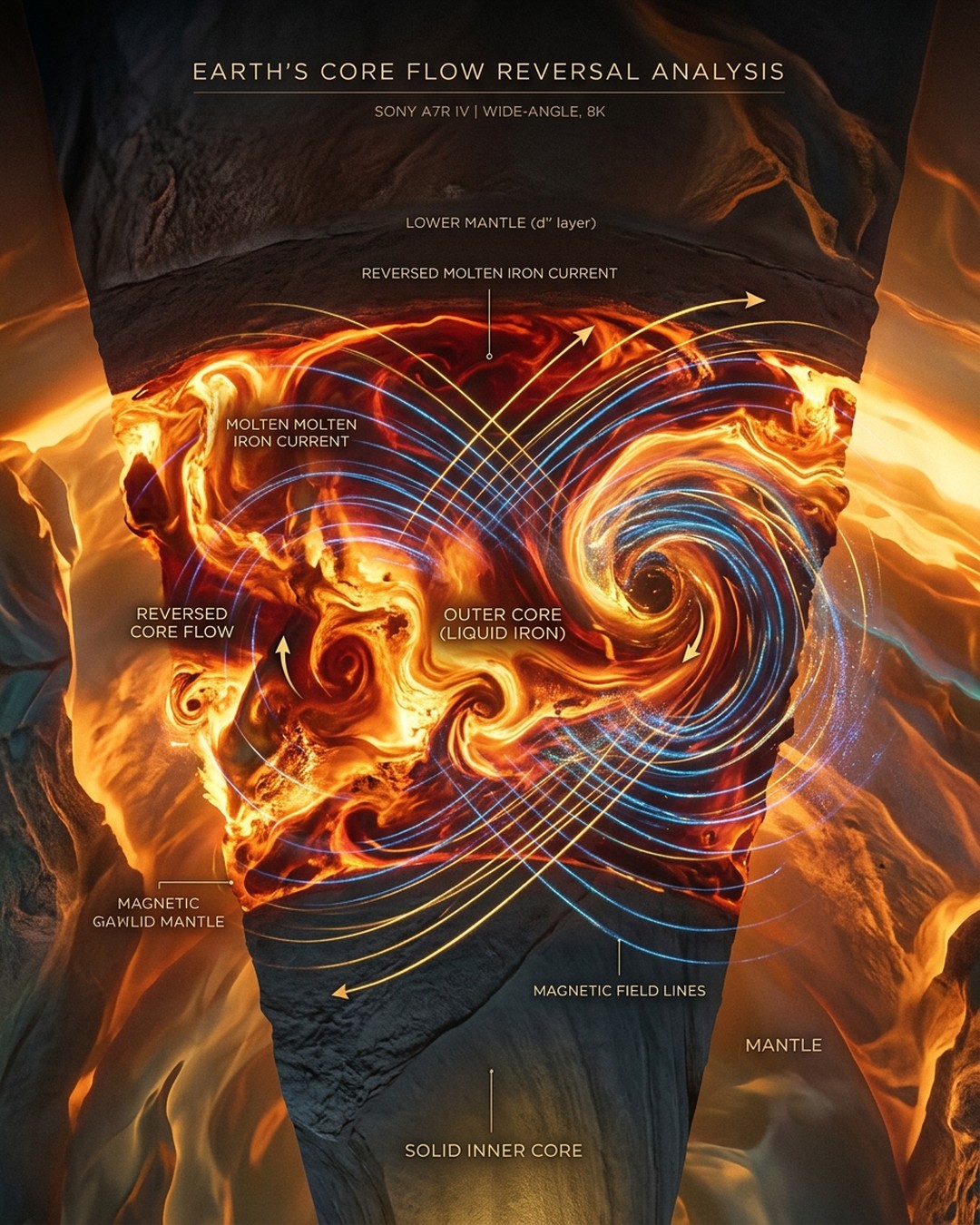
A significant and unexpected reversal in the flow of molten iron within Earth's outer core, occurring beneath the Pacific Ocean, has been identified by researchers using satellite and ground-based data. This phenomenon, which began around 2010, saw a transition from a weak westward flow to a strong eastward movement, challenging previous scientific assumptions regarding the stability of deep-core circulation.
The research team, led by Frederik Dahl Madsen, emphasizes that this event provides a rare, high-resolution look at the dynamic processes occurring approximately 2,200 kilometers beneath the surface. The findings suggest that the outer core is far more variable and complex than previously modeled, potentially indicating a deeper connection between the core, mantle, and the planet's magnetic field evolution.
By integrating data from the European Space Agency's Swarm mission with historical records from CHAMP and Ørsted satellites, scientists have reconstructed these flow patterns from 1997 to 2025. This analysis highlights that large-scale core circulation can shift abruptly within a decade, rather than evolving only through gradual, long-term changes.
These insights are critical for understanding the geodynamo, the mechanism that generates Earth's protective magnetic field. While these deep-earth shifts do not pose immediate threats to the climate or human safety, they are essential for refining models used in navigation, satellite operations, and space weather forecasting.