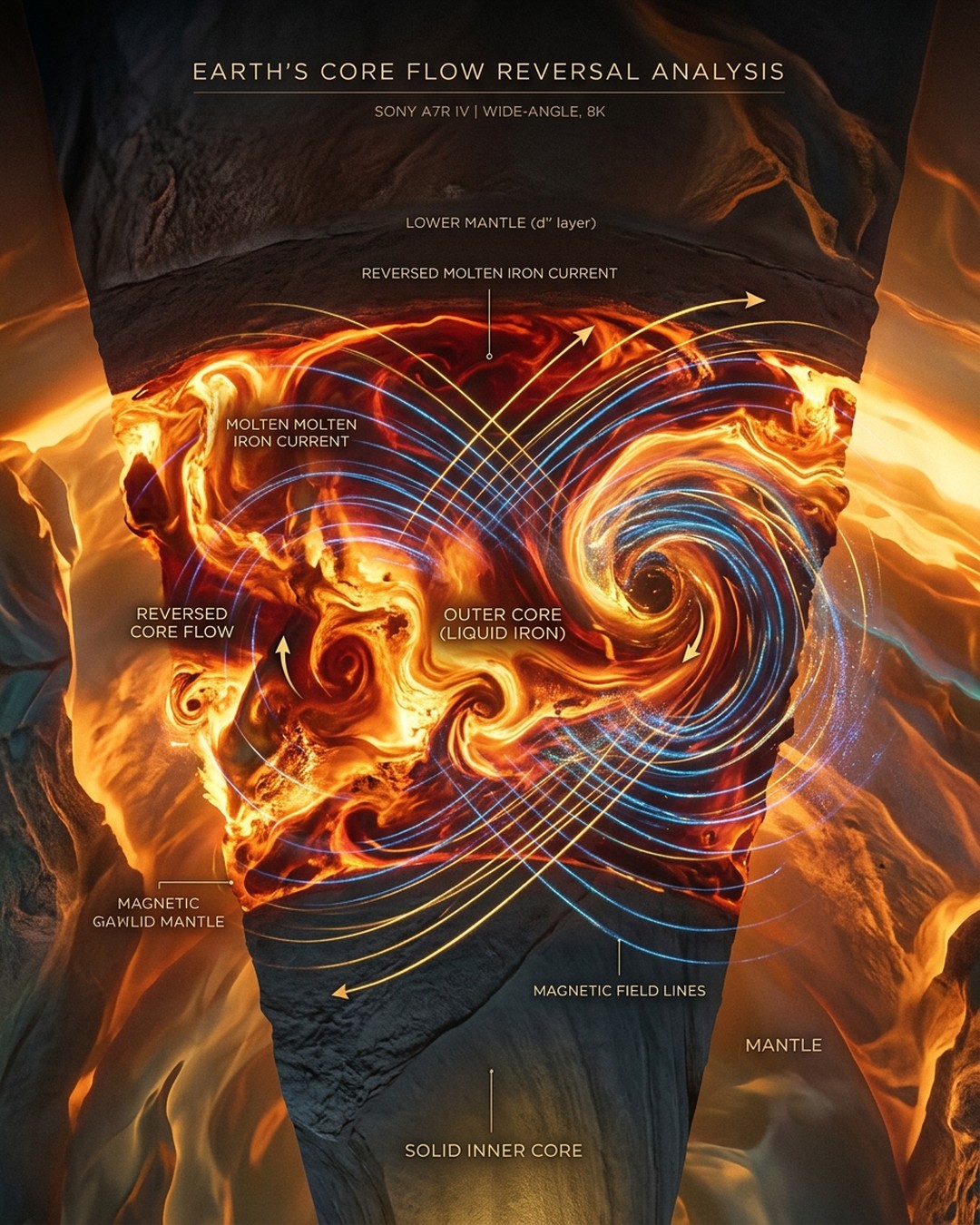
Earth's Core Flow Reversal Analysis

EarthScience Geophysics MagneticField ESA CoreDynamics

Summary

Mind Map Cover Image
AI Generated Cover Image

A significant and unexpected reversal in the flow of molten iron within Earth's outer core, occurring beneath the Pacific Ocean, has been identified by researchers using satellite and ground-based data. This phenomenon, which began around 2010, saw a transition from a weak westward flow to a strong eastward movement, challenging previous scientific assumptions regarding the stability of deep-core circulation. The research team, led by Frederik Dahl Madsen, emphasizes that this event provides a rare, high-resolution look at the dynamic processes occurring approximately 2,200 kilometers beneath the surface. The findings suggest that the outer core is far more variable and complex than previously modeled, potentially indicating a deeper connection between the core, mantle, and the planet's magnetic field evolution. By integrating data from the European Space Agency's Swarm mission with historical records from CHAMP and Ørsted satellites, scientists have reconstructed these flow patterns from 1997 to 2025. This analysis highlights that large-scale core circulation can shift abruptly within a decade, rather than evolving only through gradual, long-term changes. These insights are critical for understanding the geodynamo, the mechanism that generates Earth's protective magnetic field. While these deep-earth shifts do not pose immediate threats to the climate or human safety, they are essential for refining models used in navigation, satellite operations, and space weather forecasting.

Key Points

01

🔹 Discovery of Pacific Core Flow Reversal

In 2010, a massive region of molten iron deep beneath the equatorial Pacific Ocean abruptly reversed its direction. The flow shifted from a weak westward movement to a strong eastward current, a change that was previously unexpected by the scientific community.

02

🔸 Methodology and Data Sources

Researchers utilized a comprehensive dataset spanning 1997 to 2025, combining ground-based magnetic measurements with high-precision data from the ESA Swarm mission, as well as the German CHAMP and Danish Ørsted satellites. This allowed for the reconstruction of flow patterns at the core-mantle boundary.

03

⭐ Implications for Core Dynamics

The study challenges the long-standing view that outer core circulation is relatively stable and changes only over decades. The observed reversal suggests that the core is highly dynamic, with regional changes capable of emerging rapidly within a single decade.

04

📊 Connection to Deep Earth Processes

The eastward flow peak occurred alongside behavioral changes in the inner core, as inferred from seismology and geodesy. Scientists hypothesize that these shifts are linked to turbulent processes at the core-mantle boundary, suggesting a complex, interconnected system deep within the planet.

05

💡 Practical Significance

Understanding these core dynamics is vital for maintaining the accuracy of navigation systems and satellite operations. Because the geodynamo (the process generating the magnetic field) is constantly evolving, these findings help improve models of near-Earth space weather and the long-term evolution of the magnetic shield.

Want to create your own mindmap?

Login to Neumap AI and start creating your own mindmaps!

Get Started