Hidden Toxic Metal Pollution Impact on Bumblebees vs Honeybees

scitechdaily university-of-cambridge environmental-science biology pollution bees

Samenvatting

Mindmap Omslagafbeelding
AI Gegenereerde Omslagafbeelding

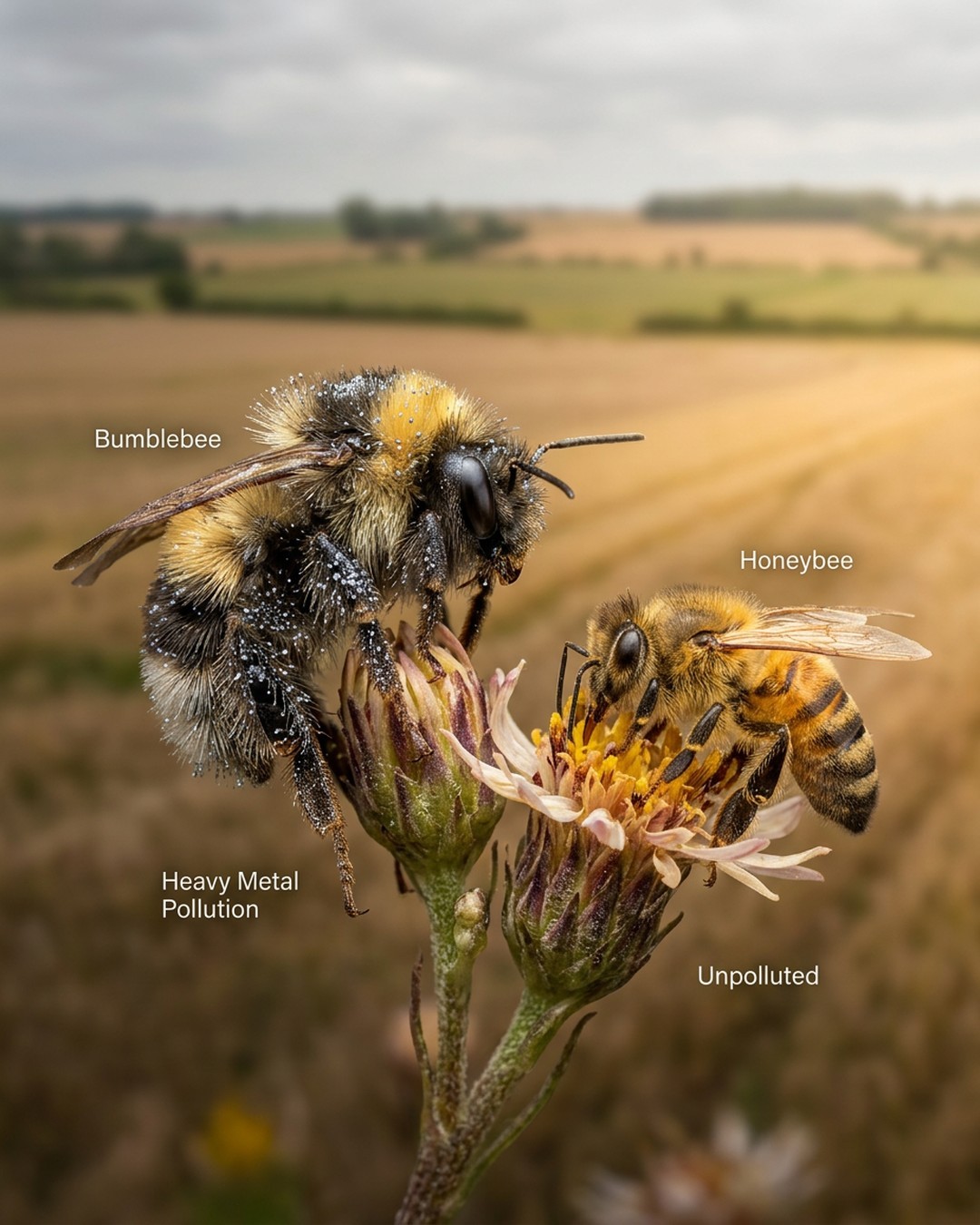
Recent research published on September 17, 2026, by a University of Cambridge team in the journal Ecological Entomology reveals that bumblebees accumulate significantly higher concentrations of toxic heavy metals in their pollen and bodies than honeybees sharing the exact same rural landscapes in Cambridgeshire. The study investigated arsenic, cadmium, chromium, cobalt, lead, and tin, discovering that bumblebee pollen contained toxic metal concentrations between two and seven times those found in honeybee pollen, while bumblebee bodies carried roughly three times the concentration, demonstrating that honeybees are unreliable indicators of heavy metal exposure for other wild bee species. The disparity in metal accumulation stems from fundamental differences in foraging behavior, biology, and nesting habits, as honeybees travel up to 10 kilometers and diversify their floral sources, whereas bumblebees stay within 1.5 kilometers and collect from fewer local plants, making them more vulnerable to localized contamination from sewage sludge, agrochemicals, and fertilizers. Although metal levels are typically insufficient to cause immediate death, even low concentrations can impair learning, memory, navigation, foraging efficiency, and reproductive success, which poses a severe threat given that bumblebee colonies contain only 50 to 500 workers compared to honeybee colonies of 30,000 to 60,000 individuals.

Belangrijke punten

01

🔹 Differential Heavy Metal Accumulation Between Bee Species

Research published on September 17, 2026, by University of Cambridge scientists in Ecological Entomology found that bumblebees foraging alongside honeybees in Cambridgeshire carried substantially higher toxic metal loads. For most metals tested, pollen collected by bumblebees showed concentrations between two and seven times higher than honeybee pollen, and bumblebee bodies contained roughly three times the metal concentrations of honeybees despite sharing the same landscape (evidenceIds: S0007, S0020, S0021).

02

🔸 Specific Toxic Elements and Low Contamination Context

The Cambridge Department of Zoology team measured arsenic, cadmium, chromium, cobalt, lead, and tin at apiaries located in rural areas with typically low soil metal contamination. The findings demonstrate that even in areas considered safe or low-risk, away from major industrial or mining centers, bees still encounter and accumulate toxic elements (evidenceIds: S0022, S0024).

03

⭐ Behavioral and Biological Causes of Disparity

The unequal accumulation is driven by foraging range and nesting differences. Honeybees travel up to 10 kilometers (6.2 miles) and visit a wide variety of flowers, diluting contamination, while bumblebees stay within 1.5 kilometers (0.9 miles), visiting fewer plant sources. Furthermore, bumblebees nest underground in soil or leaf litter and are hairier, making them prone to trapping dust and airborne metal particles (evidenceIds: S0028, S0029, S0032).

04

📊 Health Impacts on Vulnerable Bumblebee Colonies

While metal levels were generally not high enough to cause immediate mortality, low concentrations impair learning, memory, navigation, food gathering, and reproduction. Because a typical bumblebee colony contains only 50 to 500 individuals compared to 30,000 to 60,000 in a honeybee hive, the loss of individual workers has a catastrophic impact on overall colony function (evidenceIds: S0025, S0026).

05

💡 Environmental Pathways and Conservation Takeaways

Metals reach rural environments via air transport, sewage sludge, agrochemicals, and fertilizers, contaminating soil, dust, and pollen. Despite these risks, senior author Professor Lynn Dicks and Dr. Sarah Scott emphasize that people should continue planting flowers for bees, as having some food contaminated with heavy metals is ultimately better than having no food at all for biodiversity and food security (evidenceIds: S0031, S0033).

Wilt u uw eigen mindmap maken?

Log in op Neumap AI en begin met het maken van uw eigen mindmaps!

Aan de Slag